
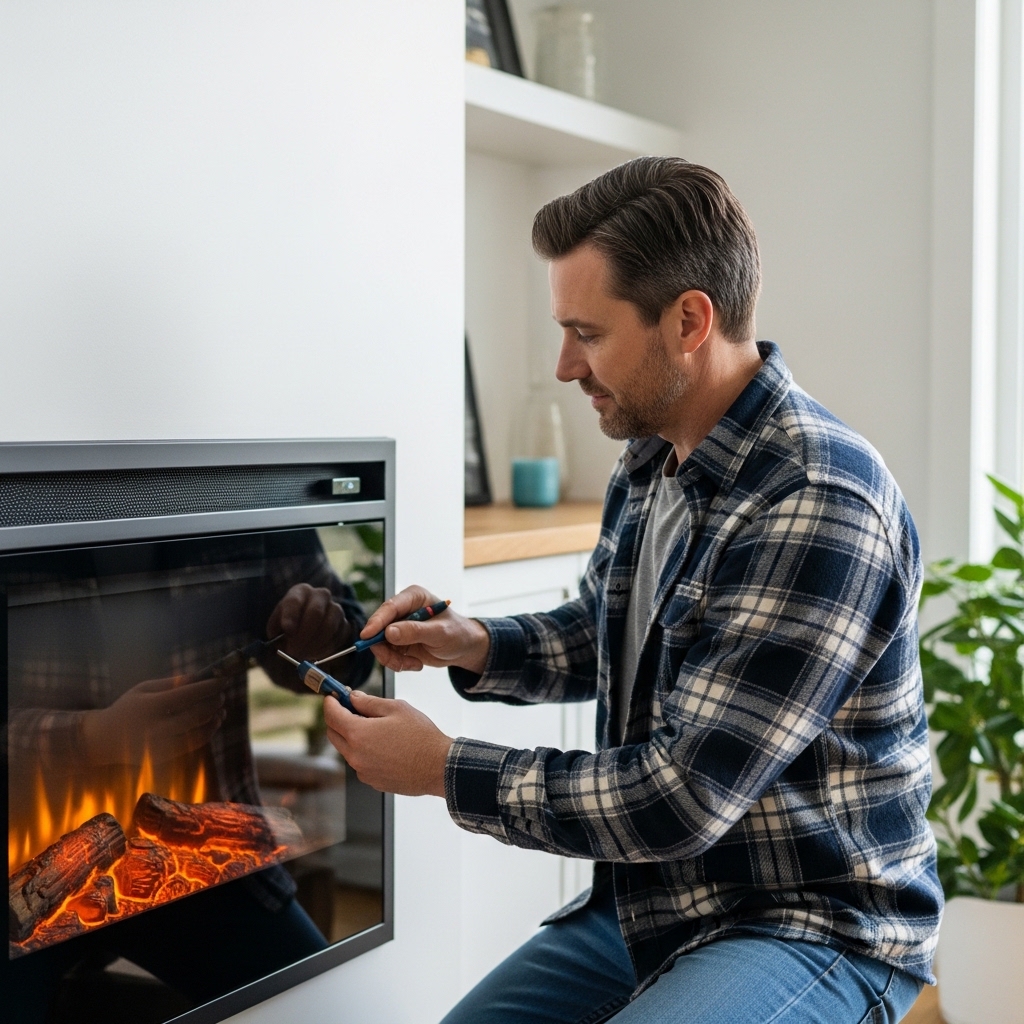

An unfamiliar gas fireplace can make a simple question feel like a plumbing project. But how to hook up a ventless gas fireplace is not a one-size-fits-all DIY procedure: the appliance, fuel supply, room, and local requirements all affect what’s allowed. A vent-free fireplace does not use a chimney flue to carry combustion products outdoors, but that does not mean it can be placed or connected anywhere.
Start with the exact appliance manual, its fuel designation, and the home’s existing gas setup. The products listed below include vent-free models as well as a vented gas-log set, and those configurations aren’t interchangeable. For context on related fireplace choices, see our guide to gas fireplace options and our overview of flame-style gas fireplaces. Both can help clarify the difference between a fireplace’s appearance and its installation requirements.


Pros
- Dual-fuel flexibility allows connection to either home natural gas lines or liquid propane tanks.
- Thermostatic temperature cycling eliminates the need for frequent manual flame adjustments.
- Built-in Oxygen Depletion Sensor pilot provides essential monitoring for indoor unvented gas combustion.
- Complete package includes the mantel surround, firebox, mesh screen, iron grate, and four ceramic logs.
Cons
- Vent-free combustion units are subject to local code restrictions and may not be approved in all jurisdictions or compact rooms.
- Product dimensions in listing details show conflicting measurements that require confirmation prior to delivery.
The ProCom FS100T-3AS is a freestanding ventless gas fireplace system designed for homeowners looking to introduce supplemental zone heating and hearth aesthetics without building a masonry chimney or cutting an exterior flue. Finished in an Apple Spice stain with subtle distressing and burnished edges, this complete fireplace package pairs a furniture-grade mantel with an integrated gas firebox. It caters to property owners who want the visual ambiance of glowing ceramic logs alongside reliable gas heat in living areas where venting infrastructure is absent or impractical to install.
At the core of the system is a 10,000 BTU vent-free burner engineered to operate at a listed 99.9 percent efficiency. The manufacturer rates this heat output for spaces up to 500 square feet, though actual temperature changes depend heavily on home insulation levels, ceiling height, and prevailing layout. A built-in thermostatic control monitors ambient temperature and cycles the burner on and off to maintain a chosen comfort level. Because it incorporates dual-fuel engineering, the burner accommodates connections to either natural gas or liquid propane supplies without demanding separate conversion kits.
Aesthetic detailing includes four hand-painted ceramic fiber logs arranged over a sturdy iron grate, surrounded by an integrated mesh safety screen that softens the firebox interior. Ignition is handled by a push-button piezo system assisted by a single AAA battery, eliminating the need to connect the fireplace to a standard 120-volt electrical wall outlet. For indoor operating safety, the assembly integrates a pilot Oxygen Depletion Sensor (ODS). This mechanism is designed to automatically shut off gas flow to the burner if unburned carbon monoxide or depleted oxygen levels are detected in the room.
Proper planning is critical before positioning this unit in a home. The manufacturer specifies a mandatory vertical clearance of at least 42 inches between the top of the mantel and the ceiling to prevent heat buildup. Because ventless gas appliances release combustion moisture and byproducts directly into indoor air, buyers must confirm that local municipal building codes permit vent-free gas hearth appliances, as some jurisdictions and room classifications prohibit them. Connecting the appliance to an existing gas supply line should always be handled by a licensed professional to ensure leak-free operation and compliant line pressures.
Prospective buyers should also take note of listed measurement variations, as the product specifications cite 40 by 48 by 24 inches while feature bullets state 12.5 inches high by 36.5 inches wide by 28 inches deep. Confirming physical floor clearance and ceiling distance ahead of delivery will avoid spatial conflicts. For spaces where ventless heating is permitted and a traditional finished appearance is desired, the ProCom FS100T-3AS provides an adaptable dual-fuel hearth option that requires no external ductwork.
The ProCom FS100T-3AS features patented dual-fuel technology that allows homeowners to fuel the unit with either natural gas or liquid propane. This dual-fuel capability eliminates the guesswork of matching fuel types or purchasing third-party conversion kits prior to setup.
The ignition assembly uses a battery-assisted push-button piezo system powered by one AAA battery, which comes included with the fireplace. Because the ignition and thermostat operate mechanically and with battery assistance, the unit does not require an active electrical wall outlet or dedicated electrical circuit.
As a vent-free system, this fireplace discharges heat directly into the living space without the use of an outdoor vent pipe, B-vent, or chimney flue. The manufacturer notes a 99.9 percent efficiency rating for heat delivery into the room.
Safety and placement guidelines require a strict vertical clearance of at least 42 inches from the top of the fireplace mantel to the ceiling. Ventless gas appliances are governed by municipal codes that vary by state and city, so buyers should review local regulations and room square footage requirements before installation.
The system ships as a comprehensive package that includes the ventless gas firebox, an Apple Spice furniture-grade mantel with distressed detailing, and an integrated protective mesh screen.
Inside the firebox, the setup includes an iron grate, four hand-painted ceramic fiber faux logs designed for gas hearth use, and one AAA battery to operate the push-button piezo ignition system.

Pros
- Asbestos-free basalt and diabase mineral composition ensures non-toxic fireplace ember effects
- Dual-media blend includes vermiculite flakes that add shimmer and help distribute gas across the burner
- Broad compatibility covering both natural gas and liquid propane fuel systems across vented and ventless fireplaces
- Supplies 10 ounces of lightweight media, providing ample volume for standard residential burner pans
Cons
- Requires careful, loose placement during setup, as packing embers too densely over gas ports can obstruct burner ventilation
- Restricted strictly to gas fireplace ember simulation and cannot be used as thermal insulation or in wood-burning fireboxes
The GASPRO 10-ounce rock wool glowing embers and vermiculite blend is designed for homeowners and fireplace owners who want to enhance the visual appeal of their existing gas log sets. Over time, original glowing embers in a gas fireplace can deteriorate or lose their visual impact. This replacement media provides a fresh ember bed that simulates glowing coals, giving natural gas and propane fireplaces a more authentic appearance without requiring structural hearth modifications.
Constructed from selected basalt and diabase rock wool alongside natural vermiculite flakes, the mixture is asbestos-free and non-toxic. When exposed to gas flames, the fine rock wool fibers glow brightly to mimic burning embers. The included vermiculite flakes, which resemble mica, serve a functional purpose by helping disperse fuel evenly across the burner pan. This dispersion promotes a more consistent flame pattern and helps minimize noticeable cold spots across the log set.
Compatibility is a key consideration for decorative hearth media, and this blend is formulated for versatile fuel and venting setups. It functions with both natural gas and liquid propane burners, and it is suitable for installation in vented or ventless gas fireplaces. Beyond aesthetic ember glowing, the media can also be scattered lightly across the base of the hearth to conceal metal burner pans and plumbing connections, creating a cleaner finished look beneath ceramic or refractory logs.
Proper installation is essential for both appearance and safe fireplace operation. The manufacturer notes that embers should never be packed tightly or piled into dense mounds over burner ports, as gas flames require adequate airflow and ventilation to breathe correctly. Placing embers too densely can disrupt fuel flow or cause improper combustion. Homeowners should always review their gas appliance manual to confirm decorative media guidelines and ensure burner openings remain unobstructed.
This media is engineered exclusively for decorative ember simulation in gas fireplaces and gas log sets. It is not designed to serve as an insulation blanket, stove liner, or fire-pit thermal barrier, nor should it be used in wood-burning fireplaces. For buyers seeking an economical aesthetic refresh that improves flame glow and conceals bare burner pans in vented or unvented gas appliances, this 10-ounce rock wool and vermiculite package offers a practical solution.
This glowing ember blend is specified for use in gas fireplaces and decorative gas log sets. It is compatible with both vented and ventless configurations, accommodating systems plumbed for either natural gas or liquid propane fuel.
Because it is designed strictly for gas-fueled hearth appliances, this media should not be added to wood-burning fireplaces, pellet stoves, or outdoor charcoal setups. It is also not rated as thermal insulation for wood stoves or fire pits.
Before applying new glowing embers, turn off the gas supply and ensure the fireplace and burner pan are completely cool. Remove old, degraded media and clean any loose dust from the burner area according to your fireplace manufacturer guidelines.
Gently pull apart the rock wool into light, wispy tufts rather than leaving it in dense clumps. Scatter the tufts and vermiculite flakes loosely around the burner ports. Avoid covering ports too thickly so fuel and combustion air can circulate freely.

Pros
- Includes all core accessories such as burner, ceramic logs, glowing embers, volcanic rock, and remote receiver in a single set.
- Built-in Oxygen Depletion Sensor provides an integrated safety shutoff mechanism for ventless operation.
- Compact footprint accommodates firebox openings as small as 20 inches wide by 13 inches deep.
- Remote control offers convenient on and off flame operation from across the room.
Cons
- Listing title and feature bullets contain conflicting fuel statements between liquid propane and natural gas, requiring confirmation of the burner label prior to piping.
- Ventless gas appliances are subject to local code restrictions and cannot be installed in certain jurisdictions or room types.
The Americangaslogs 18-Inch Ventless Gas Log Set is designed for existing masonry or factory-built fireboxes approved for unvented gas appliances. This package is aimed at homeowners seeking supplemental heating and the ambiance of a glowing fire without the maintenance of cordwood or the heat loss associated with open chimney dampers. Because ventless gas logs operate inside an enclosed hearth area without requiring an active flue, they present a viable alternative for spaces where chimney venting is either nonfunctional or absent.
According to manufacturer specifications, this burner system delivers up to 36,000 BTU of heat output with a listed 99.9% heating efficiency. The listing notes supplemental coverage of up to 1,000 square feet, though actual heating performance will vary based on ceiling height, home insulation, and room layout. The set includes a battery-assisted ignition system for quick startup and features a wireless remote control for turning the flame on and off, along with manual adjustment options for modulating the flame presentation.
The complete kit supplies realistic ceramic logs with birch detailing, a gas burner assembly, volcanic rock, and glowing embers to distribute along the base for added visual depth. Safety is managed through an integrated Oxygen Depletion Sensor (ODS), an essential mechanism for ventless indoor gas hearths that automatically cuts the fuel supply if oxygen levels drop below safe thresholds. Hardware and a remote receiver are also packaged together, simplifying the process of sourcing compatible accessories for a standard installation.
Proper hearth sizing is critical before purchasing this assembly. The manufacturer specifies that the burner and log arrangement requires minimum firebox dimensions of 14 inches in height, 20 inches in front width, and 13 inches in depth. Buyers must measure the internal floor of their fireplace rather than the exterior surround, ensuring sufficient clearance from sidewalls and combustible mantels. Because gas line plumbing involves building codes and safety regulations, a qualified gas technician should manage the pipe connection, leak testing, and pressure verification.
A significant consideration for prospective buyers is a discrepancy in the product listing itself. While the product title mentions liquid propane, the detailed feature bullets and model description specify natural gas use only. Propane and natural gas operate at different line pressures and require distinct burner orifice sizes. Before making any gas connections, owners must check the metal rating plate attached to the burner chassis to verify the exact fuel type for which the valve and orifices are calibrated, as operating with the incorrect fuel poses severe fire and soot hazards.
For homeowners with compatible fireboxes, appropriate local building approvals, and verified gas supply lines, this log set offers an all-inclusive heating upgrade with remote convenience. However, buyers should confirm municipal ventless gas regulations, verify that the physical hearth dimensions exceed the 20-inch width requirement, and verify the appliance data plate upon delivery before hiring an installer.
This 18-inch log set requires a firebox with minimum interior clearances of 14 inches in height, 20 inches in front width, and 13 inches in depth. Hearth owners should measure the narrowest point of the firebox, particularly if the rear wall tapers inward, to guarantee proper fit without crowding the burner assembly.
Maintaining adequate space around the burner is critical for combustion air flow and to prevent ceramic logs from impinging directly on sidewalls or screens. Always cross-reference the appliance manual for clearance to mantels, glass doors, and combustible furnishings prior to finalizing placement.
Ventless gas hearth appliances rely on room air for combustion, making safety features paramount. This unit incorporates an Oxygen Depletion Sensor (ODS) paired with battery-assisted ignition, designed to automatically shut off gas flow if room oxygen levels decrease or if the pilot flame is extinguished.
Due to conflicting details in the product title and description regarding liquid propane versus natural gas, users must confirm the factory-set fuel type stamped on the burner rating plate prior to hookup. Never attempt to convert or connect a gas appliance to an unlisted fuel source without manufacturer-approved components and certified professional installation.
Local building codes and regional regulations vary regarding the installation of unvented gas appliances. Certain states, municipalities, and specific room types such as bedrooms or bathrooms may prohibit or restrict ventless gas logs, so checking local ordinances before purchase is essential.

Pros
- Dual-fuel flexibility allows switching between natural gas and propane based on fuel availability.
- Ventless design avoids the expense and structural modifications of chimney installation.
- Zero-clearance firebox allows straightforward integration into custom mantels or recessed wall cavities.
- Comes complete with ceramic log set, iron grate, mesh screen doors, and remote receiver.
Cons
- Ventless gas appliances are subject to regional building code restrictions and may be prohibited in specific jurisdictions or bedrooms.
- Flame height modulation must be adjusted manually on the firebox valve rather than through the remote control.
The Duluth Forge FDF400RT-ZC is a dual-fuel ventless gas fireplace insert engineered to serve as a supplemental heat source or visual centerpiece in residential living areas. Designed for homeowners seeking the ambiance and heat of a traditional hearth without venting through an exterior chimney or flue, this insert fits well into custom recessed wall framing, prefabricated cabinetry, or existing masonry openings with access to a gas supply line. Because vent-free appliances release combustion byproducts into the living area, buyers must always verify local municipal codes and room-size guidelines before selecting a ventless model.
At the core of the insert is a burner rated by the manufacturer at 32,000 BTU, with a listed heating capability of up to 1,500 square feet. The unit features patented dual-fuel technology, allowing it to burn either natural gas or liquid propane depending on household utility connections. Starting the appliance relies on a push-button piezo ignition that lights a standing pilot. From there, users can turn the main flame on or off using the included handheld remote control with an LCD display, while flame height adjustments are handled manually at the control valve.
Visually, the insert replicates the look of an established hearth through six hand-painted ceramic fiber logs arranged over an iron grate, complemented by an interior sprayed brick liner. The black exterior measures approximately 29.1 inches wide, 29.5 inches deep, and 15.6 inches high, weighing roughly 70 pounds. Protective mesh double doors enclose the firebox face, creating a classic screened finish while maintaining an unobstructed view of the fire. The package also includes the remote receiver and a AAA battery to get the remote operational right away.
The zero-clearance construction permits the firebox to sit directly against framing studs or non-combustible materials when installed according to the manual. However, specific spatial clearances must be maintained, including a minimum of 42 inches between the top of the fireplace and the ceiling. Because proper gas line hookups, pressure regulation, and leak checks are vital for safe gas operation, hiring a qualified, licensed gas technician is strongly advised. Routine maintenance involves dusting the ceramic logs, clearing the burner ports of debris, and replacing remote batteries as needed.
Overall, the Duluth Forge FDF400RT-ZC presents an adaptable option for property owners wanting powerful supplemental heat and fuel flexibility in an all-in-one package. Its lack of required chimney venting can significantly streamline renovation budgets compared to vented alternatives. Prospective buyers should confirm their local building codes regarding ventless combustion appliances, ensure their room volume matches manufacturer minimums, and review gas line access before finalizing their purchase.
The zero-clearance firebox design allows this insert to be recessed into standard framing or built directly into a wall cavity, provided a qualified gas supply is available. The manufacturer specifies a mandatory clearance of at least 42 inches from the top of the appliance to the ceiling to ensure adequate thermal dispersion and prevent heat damage to surrounding finishes.
Because ventless appliances operate without an exhaust duct or chimney, they utilize room air for combustion. Prospective installers should verify that the room provides adequate cubic volume and ventilation as dictated by manufacturer instructions and local regulations. Gas line connections, fuel type configuration, and initial pressure testing should always be performed by a licensed professional.
Featuring dual-fuel capability, this insert can be connected to either an existing natural gas supply or a dedicated liquid propane tank line. The internal system operates at up to 32,000 BTU, providing high-efficiency zone heating directly into the living space without the draft losses associated with open chimneys.
Ignition is initiated via a push-button piezo system that activates a standing pilot. Once the pilot is established, the included remote control can cycle the main burner on and off. Users can fine-tune flame intensity and heat output using the manual control knob located behind the unit access panel.
The Duluth Forge FDF400RT-ZC arrives with the zero-clearance black firebox, integrated burner assembly, and an internal sprayed brick liner. Decorative components include six hand-painted ceramic fiber faux logs, an iron grate, and protective mesh double doors.
For operational control, the package contains a handheld remote control with an LCD screen, a corresponding remote receiver, and a single AAA battery to power the handheld transmitter.
Pros
- Flexible dual-fuel capability allows operation with either natural gas or liquid propane lines.
- Thermostatic cycling helps regulate room comfort automatically without continuous manual adjustments.
- Zero-clearance design provides flexible installation options for recessed framing or custom mantel cabinets.
- Ventless configuration eliminates the need for an external chimney, flue, or venting ductwork.
Cons
- Ventless gas appliances are subject to regional and local code restrictions that must be verified prior to installation.
- Requires a minimum 42-inch clearance from the top of the unit to the ceiling, which may restrict placement in rooms with low ceiling heights.
The Duluth Forge FDF400T-ZC is a zero-clearance, ventless gas fireplace insert engineered for homeowners seeking powerful supplemental heat without the structural demands of an exterior chimney or flue. Designed for indoor installation in rooms with accessible gas piping, this unit functions effectively as a replacement insert inside a suitable fireplace opening or as the core component of a custom-built mantel enclosure. Its dual-fuel configuration makes it an adaptable option for property owners utilizing either utility natural gas or bottled liquid propane.
At the center of its operation is a dual-fuel burner capable of producing up to 32,000 BTUs, operating with a manufacturer-stated 99.9% vent-free efficiency rating. Duluth Forge rates this heat output for living spaces up to 1,500 square feet under typical residential conditions. The built-in thermostat control continuously monitors ambient room temperature, cycling the gas burner on and off to maintain a consistent comfort level rather than requiring ongoing manual flame adjustments. Ignition is managed by a battery-operated push-button piezo system that uses a single included AAA battery, allowing reliable startup without requiring an electrical outlet or household wiring.
Visually, the insert features a traditional fireplace appearance centered on six hand-painted ceramic fiber faux logs positioned on a heavy iron grate. The interior of the firebox features a sprayed brick liner for added depth, while the exterior presents a clean black finish accented by operable mesh double doors. Listed dimensions measure 29.1 inches wide, 29.5 inches deep, and 15.6 inches high, with a total weight of approximately 70 pounds, providing a solid footprint intended to fill standard hearth openings or custom framing cavities.
Installation requires careful review of framing clearances, gas supply requirements, and local code restrictions. Because this is a zero-clearance firebox, it is designed for recessed installation against standard wall framing or into an enclosure accessible to a gas supply. However, the manufacturer dictates that clearance between the top of the firebox and the ceiling must not be less than 42 inches. Because vent-free gas appliances release combustion byproducts directly into the room, prospective buyers should always confirm that local building codes and municipal regulations permit unvented gas appliances in their specific area prior to purchase.
The Duluth Forge FDF400T-ZC serves as an efficient heating solution for homeowners looking for substantial zone heat and versatile fuel compatibility. The absence of exterior venting simplifies placement in homes lacking an existing flue, provided that room dimensions and required ceiling clearances are strictly respected. For households with accessible gas lines seeking a dependable, thermostatically controlled hearth appliance, this model combines practical heating performance with classic fireplace aesthetics.
The zero-clearance firebox design of the Duluth Forge FDF400T-ZC enables flexible installation, whether recessed into standard interior wall framing or housed inside a compatible fireplace mantel surround. Because it does not require an external chimney, chimney liner, or exterior ducting, installation focuses primarily on proper gas line connections and structural clearance compliance.
A critical manufacturer specification is the required clearance to combustible ceilings, which must be a minimum of 42 inches measured from the top of the fireplace insert. Adequate room volume is also necessary to support proper combustion for unvented appliances. Homeowners should consult the manufacturer manual and work with a licensed gas technician to ensure correct piping, pressure regulation, and adherence to municipal codes regarding vent-free indoor heating appliances.
Featuring patented dual-fuel technology, the FDF400T-ZC is engineered to operate on either natural gas or liquid propane without requiring separate conversion kits. This versatility allows homeowners to select the most economical or available fuel source for their household setup.
The burner produces up to 32,000 BTUs of supplemental heat with a 99.9% efficiency rating, as no thermal energy escapes through an exhaust vent. Duluth Forge rates this appliance to heat areas up to 1,500 square feet. An integrated thermostat automates the heating cycle to maintain target room temperatures, while the piezo ignition provides straightforward startup without relying on household electrical power.
What to Know Before Connecting a Ventless Gas Fireplace
A ventless gas fireplace must be matched to its approved fuel and installed according to its manufacturer’s instructions and applicable local requirements. Because connecting a gas appliance involves a fuel line and appliance-specific setup, use a qualified professional for the connection unless the manual and local rules clearly permit another approach. Do not improvise fittings, convert fuel types, or treat a nearby gas line as proof that the appliance can be installed there.
Identify the appliance before planning a connection
“Ventless,” “vent-free,” and “vent-free gas fireplace” generally describe a gas appliance designed to operate without a conventional chimney or vent carrying exhaust outdoors. That description does not establish that a particular unit is suitable for a particular room, jurisdiction, or home. Confirm the make, model, fuel type, installation configuration, and required clearances from the unit’s label and manual rather than relying on a retailer’s summary.
Check whether the appliance is designated for natural gas, liquid propane, or both. A dual-fuel label means the manufacturer lists options for those fuels, not that the unit can be switched casually or that every home connection will support either option. Any permitted fuel conversion must follow the exact manufacturer procedure and use the specified parts; ask a qualified gas-appliance professional to confirm the setup.
Identify whether the appliance is a complete fireplace system, an insert, or a log set intended for an existing firebox. These terms describe different configurations, and a log set is not automatically a complete fireplace. For example, the supplied HearthSense CSW18HVL is listed as a vented natural-gas log set that must be used in a masonry fireplace or vented firebox with the flue open during operation. It is not a substitute for a ventless appliance or a reason to close a fireplace damper.
Confirm room, opening, and fuel compatibility
Before installation is planned, compare the model’s stated dimensions and clearances with the proposed location. Measure the fireplace opening or installation space as the manual directs, and account for nearby walls, trim, furniture, and ceiling surfaces only as specified by the manufacturer. A dimension listed for one model does not establish the clearance for another, and product data is not a substitute for the full installation instructions.
Ask whether the home’s fuel supply is the correct type and whether the proposed connection can be assessed for that appliance. The existence of a gas line, meter, tank, or other gas appliance does not verify adequate supply, pressure, routing, or permitted installation. Those details must be checked against the appliance instructions and applicable local rules by someone qualified to assess the installation.
Room suitability needs separate attention. Vent-free appliances release combustion products and water vapor into the room by design, so follow the specific product’s room-size, ventilation, and operating instructions rather than assuming that “ventless” means unrestricted use. Requirements and restrictions can vary with the appliance and location; check local code officials or other relevant authorities and ask a qualified installer when the answer is unclear.
Renters and occupants should get the property owner’s approval before arranging a gas connection or changing an existing fireplace. A homeowner should also check whether permits, inspections, or other approvals apply in the municipality. The answer can depend on local rules and the installation, so avoid relying on a general online description as confirmation of compliance.
What the hookup process should involve
For a ventless unit, the “hookup” is more than placing the fireplace and attaching a line. The proposed location and appliance must first be confirmed against the manual, fuel designation, room conditions, and local requirements. A qualified installer can then determine how the gas supply and appliance connection should be handled for that specific model and home.
Before work begins, have the installer verify the appliance identification and explain which fuel configuration is being used. Confirm that the planned location meets the manufacturer’s stated dimensions and clearance instructions, and ask whether local approvals or inspection are needed. If the manual is missing, obtain the correct version using the full model number rather than proceeding from a similar-looking product listing.
The gas connection and any required testing should be completed according to the appliance instructions and applicable requirements by a qualified professional. This article cannot provide a safe universal sequence for routing a line, selecting fittings, adjusting pressure, checking for leaks, or commissioning different models. Those steps depend on the equipment and site, and a wrong connection can create serious hazards.
After installation, ask what was checked, how the appliance is started and shut down, and which warning signs require stopping use. Have the installer show you the model’s controls and explain the specific maintenance instructions and any limits on operating time or room conditions. Keep the manual accessible, and do not use the appliance until outstanding installation questions have been resolved.
Safety controls and operating limits matter
Some supplied vent-free product descriptions list an oxygen depletion sensor, or ODS, as a safety feature. The ProCom Dual Fuel Ventless Gas Fireplace System, for instance, is described as having a built-in pilot ODS and battery-assisted ignition. The Duluth Forge ventless inserts are described with push-button ignition, and one listing specifies a remote while another specifies thermostat control. These are manufacturer-listed features, not independent verification of safety or suitability for a home.
Never bypass, disable, or tamper with a sensor, pilot, ignition system, or other safety control. If the appliance shuts off unexpectedly, repeatedly fails to ignite, produces an unusual odor, or behaves differently from its manual, stop using it and consult the manufacturer or a qualified service professional. Do not keep relighting a unit to see whether the problem clears.
Follow the manual’s instructions about alarms, room use, and supervision. A carbon monoxide alarm is an important home safety measure, but it does not make an improper installation acceptable or replace appliance instructions and local requirements. If an alarm sounds or anyone experiences concerning symptoms while a gas appliance is operating, leave the area and contact emergency services or the appropriate utility from a safe location.
Keep the appliance and its required clearances free of items the manual prohibits, and do not modify the firebox or surround to make a unit fit. Maintain access to shutoff controls as instructed, but have a professional explain their location and operation rather than attempting repairs. If the fireplace is in a home with children, pets, or people who may have difficulty operating controls, include those practical conditions in the installation discussion.
Use the right product category for the existing fireplace
The supplied options illustrate why product type matters. The ProCom model is described as a dual-fuel ventless fireplace system with thermostat control, while the Duluth Forge listings describe dual-fuel ventless inserts with either remote or thermostat control. Their stated dimensions and clearances are model-specific information, not a general installation template.
The listed 18-27 Inch Ventless Fireplace Gas Logs Set is described as a ventless log set with remote control and an ODS, but its product description contains conflicting fuel wording: its title says it is for liquid propane, while the feature text says natural gas. Do not resolve that discrepancy by guessing. Check the manufacturer’s current manual and product label before purchase or installation, and ask the seller or manufacturer for clarification.
GASPRO Rock Wool Glowing Embers are an accessory, not a fireplace or gas connection component. The listing describes them as usable with certain vented and ventless gas fireplaces, but that broad description does not prove compatibility with every burner. Use embers only if the appliance manufacturer permits that accessory, and follow its placement instructions so burner openings and required flame paths are not obstructed.
A vented log set and a ventless insert have different venting arrangements and operating conditions. The HearthSense set explicitly requires an open flue during use, while the ProCom and Duluth Forge models are listed as ventless. Don’t use product photographs, decorative logs, or a shared brand category to infer that components can be swapped between them.
After installation: operation and ongoing care
Operate the fireplace only as its model-specific instructions describe. Ignition methods, remote controls, thermostat behavior, batteries, and flame adjustments differ by product, so instructions for one model should not be applied to another. If a control is unfamiliar or a step in the manual is unclear, ask the manufacturer or installer before using the appliance.
Maintenance requirements also depend on the appliance. Follow the manual for cleaning, inspection, approved parts, and service intervals; do not assume that a ventless unit needs no maintenance simply because it has no conventional flue. Keep records of the model, installation work, service, and replacement components so future service providers can identify the exact configuration.
Watch for changes such as repeated shutdowns, ignition problems, damaged components, or an unfamiliar odor. These signs do not identify a single cause, and guessing at a repair can make the situation worse. Stop operation when a warning or abnormal condition calls for it, then contact a qualified professional or the manufacturer’s service channel.
For related upkeep questions, our fireplace draft-control cover guide discusses a different fireplace accessory and can help distinguish accessory use from appliance installation. A cover is not a substitute for the venting arrangement or clearances specified for a gas fireplace. Confirm that any accessory is appropriate for the exact appliance before using it.
Make the connection decision from verified details
The safest next step is to gather the exact model number, manual, fuel designation, and proposed installation location before arranging the hookup. Have a qualified professional assess the gas connection and confirm which local approvals or inspections apply. If the fireplace is vented rather than ventless, or the product listing conflicts with its label, pause until the configuration is clarified.
Choosing a ventless fireplace is not simply a matter of finding a nearby gas line. The appliance must match its fuel, its installation instructions, the room, and local requirements, and occupants must understand its controls and limits. Treating those checks as prerequisites, rather than attempting a generic DIY connection, is the practical way to move forward responsibly.


Write Your Review
No reviews yet. Be the first to share your experience!