


Replacing a propane fireplace insert requires precise attention to firebox dimensions, gas line compatibility, and local building codes. The primary challenge is ensuring the new unit fits the existing structure while maintaining safe clearance distances. A replacement propane fireplace insert serves as a direct swap for aging or inefficient units, offering improved heat output and modern controls without the need for a full chimney reconstruction. Homeowners often seek these upgrades to enhance comfort in living spaces or to replace damaged components that no longer meet safety standards.
Before purchasing, it is essential to verify the specific fuel type required by your home’s infrastructure. Propane units differ significantly from natural gas models in valve pressure and burner design. Mismatching these can lead to incomplete combustion or safety hazards.
The options listed below cover various configurations, from ventless inserts that maximize heat efficiency to vented systems that require external exhaust. Each model includes specific dimensions and safety features that must align with your home’s existing setup. Understanding these technical details helps avoid costly installation errors and ensures a safe, functional upgrade.


Pros
- Dual-fuel flexibility allows switching between natural gas and propane based on fuel availability.
- Ventless design avoids the expense and structural modifications of chimney installation.
- Zero-clearance firebox allows straightforward integration into custom mantels or recessed wall cavities.
- Comes complete with ceramic log set, iron grate, mesh screen doors, and remote receiver.
Cons
- Ventless gas appliances are subject to regional building code restrictions and may be prohibited in specific jurisdictions or bedrooms.
- Flame height modulation must be adjusted manually on the firebox valve rather than through the remote control.
The Duluth Forge FDF400RT-ZC is a dual-fuel ventless gas fireplace insert engineered to serve as a supplemental heat source or visual centerpiece in residential living areas. Designed for homeowners seeking the ambiance and heat of a traditional hearth without venting through an exterior chimney or flue, this insert fits well into custom recessed wall framing, prefabricated cabinetry, or existing masonry openings with access to a gas supply line. Because vent-free appliances release combustion byproducts into the living area, buyers must always verify local municipal codes and room-size guidelines before selecting a ventless model.
At the core of the insert is a burner rated by the manufacturer at 32,000 BTU, with a listed heating capability of up to 1,500 square feet. The unit features patented dual-fuel technology, allowing it to burn either natural gas or liquid propane depending on household utility connections. Starting the appliance relies on a push-button piezo ignition that lights a standing pilot. From there, users can turn the main flame on or off using the included handheld remote control with an LCD display, while flame height adjustments are handled manually at the control valve.
Visually, the insert replicates the look of an established hearth through six hand-painted ceramic fiber logs arranged over an iron grate, complemented by an interior sprayed brick liner. The black exterior measures approximately 29.1 inches wide, 29.5 inches deep, and 15.6 inches high, weighing roughly 70 pounds. Protective mesh double doors enclose the firebox face, creating a classic screened finish while maintaining an unobstructed view of the fire. The package also includes the remote receiver and a AAA battery to get the remote operational right away.
The zero-clearance construction permits the firebox to sit directly against framing studs or non-combustible materials when installed according to the manual. However, specific spatial clearances must be maintained, including a minimum of 42 inches between the top of the fireplace and the ceiling. Because proper gas line hookups, pressure regulation, and leak checks are vital for safe gas operation, hiring a qualified, licensed gas technician is strongly advised. Routine maintenance involves dusting the ceramic logs, clearing the burner ports of debris, and replacing remote batteries as needed.
Overall, the Duluth Forge FDF400RT-ZC presents an adaptable option for property owners wanting powerful supplemental heat and fuel flexibility in an all-in-one package. Its lack of required chimney venting can significantly streamline renovation budgets compared to vented alternatives. Prospective buyers should confirm their local building codes regarding ventless combustion appliances, ensure their room volume matches manufacturer minimums, and review gas line access before finalizing their purchase.
The zero-clearance firebox design allows this insert to be recessed into standard framing or built directly into a wall cavity, provided a qualified gas supply is available. The manufacturer specifies a mandatory clearance of at least 42 inches from the top of the appliance to the ceiling to ensure adequate thermal dispersion and prevent heat damage to surrounding finishes.
Because ventless appliances operate without an exhaust duct or chimney, they utilize room air for combustion. Prospective installers should verify that the room provides adequate cubic volume and ventilation as dictated by manufacturer instructions and local regulations. Gas line connections, fuel type configuration, and initial pressure testing should always be performed by a licensed professional.
Featuring dual-fuel capability, this insert can be connected to either an existing natural gas supply or a dedicated liquid propane tank line. The internal system operates at up to 32,000 BTU, providing high-efficiency zone heating directly into the living space without the draft losses associated with open chimneys.
Ignition is initiated via a push-button piezo system that activates a standing pilot. Once the pilot is established, the included remote control can cycle the main burner on and off. Users can fine-tune flame intensity and heat output using the manual control knob located behind the unit access panel.
The Duluth Forge FDF400RT-ZC arrives with the zero-clearance black firebox, integrated burner assembly, and an internal sprayed brick liner. Decorative components include six hand-painted ceramic fiber faux logs, an iron grate, and protective mesh double doors.
For operational control, the package contains a handheld remote control with an LCD screen, a corresponding remote receiver, and a single AAA battery to power the handheld transmitter.
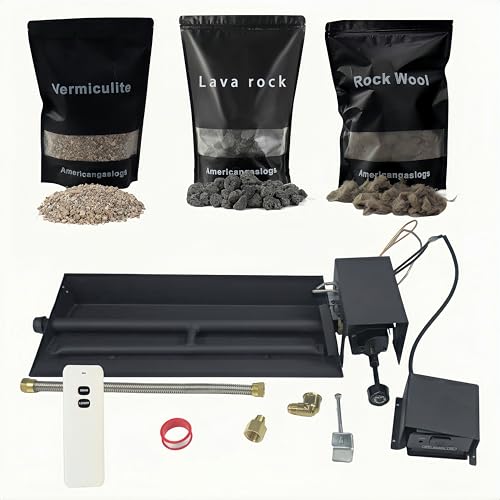
Pros
- Motorized valve and remote control make igniting and adjusting flame height effortless from across the room.
- Dual-pipe burner layout produces a fuller, more authentic flame pattern beneath gas logs.
- Comes with decorative media including volcanic rock, vermiculite, and glowing embers.
- Straightforward replacement dimensions for standard 18-inch to 24-inch vented fireplace hearths.
Cons
- Strictly designed for vented fireplaces and cannot be used in ventless or vent-free fireboxes.
- Liquid propane installations require an additional air mixer to prevent excessive soot.
- Connecting active fuel lines often requires professional gas plumbing assistance for proper safety.
The Americangaslogs 18-inch burner pan kit is an all-in-one replacement burner assembly designed for vented indoor gas fireplaces. Engineered to breathe new life into existing masonry or prefabricated hearths, this system caters to homeowners seeking to modernize older manual log setups without undertaking a full hearth renovation. Whether updating a living room centerpiece for family movie nights or restoring warmth to a chilly basement fireplace, this kit delivers a functional upgrade that pairs well with standard 18-inch to 24-inch ceramic gas log sets.
Operating on a dual-pipe burner framework, the assembly distributes fuel evenly beneath the log stack to generate full, dancing yellow flames. Unlike single-tube designs that can look sparse or artificial, the two-pipe configuration allows flames to wrap around logs and ignite the included glowing embers and vermiculite. This creates an authentic wood-fire glow and provides steady supplemental radiant warmth across typical living areas, making cold winter evenings much more comfortable.
A standout feature of this system is the integrated electronic motorized valve, accompanied by a handheld remote control. Users can ignite the burner, shut it off, and modulate flame height directly from their favorite armchair. The sturdy pan construction measures 18 inches long by 6 inches wide with standard half-inch NPT fittings, providing a solid foundation that resists warping under prolonged heat exposure. The included pilot assembly ensures reliable ignition while maintaining safe flame management during extended heating sessions.
Installation is relatively straightforward for experienced DIYers, as the package contains the burner pan, copper connection tubing, sealing tape, and decorative fireplace media. However, because this unit hooks into active gas lines, taking proper safety precautions such as testing all joints with soapy water or consulting a certified gas technician is essential. Routine maintenance involves periodically clearing dust from the pilot and ensuring the burner ports remain clear of debris.
Keep in mind that this burner pan is strictly intended for vented fireplaces where the damper stays open during use; it cannot be installed in vent-free enclosures. Furthermore, while it supports both natural gas and propane, propane setups require an appropriate air mixer to prevent soot buildup. For homeowners looking to restore lively flames and remote-controlled convenience to a tired vented fireplace, this package offers a complete, budget-conscious solution that enhances both ambiance and supplemental comfort.
The motorized electronic valve eliminates the need to reach into a hot fireplace to turn manual knobs or light matches. With the included wireless remote control, you can turn the fire on or off and adjust flame levels to suit your desired warmth and room atmosphere.
This level of control is ideal for relaxed evenings in the living room or family room, allowing you to easily fine-tune flame height for either dramatic ambiance or subtle supplemental heat without leaving your seat.
This kit arrives with nearly everything required to refresh your firebox floor. It includes the 18-inch dual-pipe burner pan, pilot assembly, motorized gas valve, handheld remote, copper connector kit, and sealing tape.
To achieve a natural wood-fire appearance right out of the box, Americangaslogs also provides volcanic rock, vermiculite, and glowing embers, giving your existing ceramic logs a rich and realistic glowing foundation.
Pros
- Flexible dual-fuel capability allows operation with either natural gas or liquid propane lines.
- Thermostatic cycling helps regulate room comfort automatically without continuous manual adjustments.
- Zero-clearance design provides flexible installation options for recessed framing or custom mantel cabinets.
- Ventless configuration eliminates the need for an external chimney, flue, or venting ductwork.
Cons
- Ventless gas appliances are subject to regional and local code restrictions that must be verified prior to installation.
- Requires a minimum 42-inch clearance from the top of the unit to the ceiling, which may restrict placement in rooms with low ceiling heights.
The Duluth Forge FDF400T-ZC is a zero-clearance, ventless gas fireplace insert engineered for homeowners seeking powerful supplemental heat without the structural demands of an exterior chimney or flue. Designed for indoor installation in rooms with accessible gas piping, this unit functions effectively as a replacement insert inside a suitable fireplace opening or as the core component of a custom-built mantel enclosure. Its dual-fuel configuration makes it an adaptable option for property owners utilizing either utility natural gas or bottled liquid propane.
At the center of its operation is a dual-fuel burner capable of producing up to 32,000 BTUs, operating with a manufacturer-stated 99.9% vent-free efficiency rating. Duluth Forge rates this heat output for living spaces up to 1,500 square feet under typical residential conditions. The built-in thermostat control continuously monitors ambient room temperature, cycling the gas burner on and off to maintain a consistent comfort level rather than requiring ongoing manual flame adjustments. Ignition is managed by a battery-operated push-button piezo system that uses a single included AAA battery, allowing reliable startup without requiring an electrical outlet or household wiring.
Visually, the insert features a traditional fireplace appearance centered on six hand-painted ceramic fiber faux logs positioned on a heavy iron grate. The interior of the firebox features a sprayed brick liner for added depth, while the exterior presents a clean black finish accented by operable mesh double doors. Listed dimensions measure 29.1 inches wide, 29.5 inches deep, and 15.6 inches high, with a total weight of approximately 70 pounds, providing a solid footprint intended to fill standard hearth openings or custom framing cavities.
Installation requires careful review of framing clearances, gas supply requirements, and local code restrictions. Because this is a zero-clearance firebox, it is designed for recessed installation against standard wall framing or into an enclosure accessible to a gas supply. However, the manufacturer dictates that clearance between the top of the firebox and the ceiling must not be less than 42 inches. Because vent-free gas appliances release combustion byproducts directly into the room, prospective buyers should always confirm that local building codes and municipal regulations permit unvented gas appliances in their specific area prior to purchase.
The Duluth Forge FDF400T-ZC serves as an efficient heating solution for homeowners looking for substantial zone heat and versatile fuel compatibility. The absence of exterior venting simplifies placement in homes lacking an existing flue, provided that room dimensions and required ceiling clearances are strictly respected. For households with accessible gas lines seeking a dependable, thermostatically controlled hearth appliance, this model combines practical heating performance with classic fireplace aesthetics.
The zero-clearance firebox design of the Duluth Forge FDF400T-ZC enables flexible installation, whether recessed into standard interior wall framing or housed inside a compatible fireplace mantel surround. Because it does not require an external chimney, chimney liner, or exterior ducting, installation focuses primarily on proper gas line connections and structural clearance compliance.
A critical manufacturer specification is the required clearance to combustible ceilings, which must be a minimum of 42 inches measured from the top of the fireplace insert. Adequate room volume is also necessary to support proper combustion for unvented appliances. Homeowners should consult the manufacturer manual and work with a licensed gas technician to ensure correct piping, pressure regulation, and adherence to municipal codes regarding vent-free indoor heating appliances.
Featuring patented dual-fuel technology, the FDF400T-ZC is engineered to operate on either natural gas or liquid propane without requiring separate conversion kits. This versatility allows homeowners to select the most economical or available fuel source for their household setup.
The burner produces up to 32,000 BTUs of supplemental heat with a 99.9% efficiency rating, as no thermal energy escapes through an exhaust vent. Duluth Forge rates this appliance to heat areas up to 1,500 square feet. An integrated thermostat automates the heating cycle to maintain target room temperatures, while the piezo ignition provides straightforward startup without relying on household electrical power.
Key Considerations for Propane Fireplace Inserts
Selecting the correct insert involves more than just matching the physical size of the opening. You must evaluate the heating capacity, venting requirements, and control mechanisms that suit your specific usage patterns. The following table outlines the critical specifications for the available options, helping you compare them against your home’s existing infrastructure. Pay close attention to the clearance requirements, as these dictate how close the unit can be placed to combustible materials.
| Model Type | Fuel Source | Heating Capacity | Venting Requirement | Key Control Feature |
|---|---|---|---|---|
| Ventless Insert | Propane / Natural Gas | 32,000 BTU | None (Vent-Free) | Remote or Thermostat |
| Vented Burner Kit | Propane / Natural Gas | Varies by Log Set | Required (Chimney/Vent) | Manual or Motorized Valve |
| Replacement Valve Kit | Low Pressure LPG | Up to 50,000 BTU | Depends on System | Push Button Igniter |
Propane gas requires specific pressure settings that differ from natural gas. Many modern inserts use dual-fuel technology, allowing you to switch between sources, but this requires a converter kit. If your home is already plumbed for propane, ensure the regulator is set to the correct low-pressure rating.
The manufacturer specifications list the maximum BTU rating for each unit, which should not exceed the capacity of your gas line. Exceeding these limits can cause dangerous pressure spikes or flame instability. Always verify the BTU output against your home’s ventilation and air quality requirements.
- Measure the firebox depth, width, and height to ensure the insert fits.
- Check the ceiling clearance, which often requires at least 42 inches.
- Confirm whether the unit is ventless or requires a chimney connection.
- Verify the gas line pressure matches the insert’s low-pressure requirement.
- Inspect the existing gas valve for wear or corrosion before installation.
- Ensure the remote control or thermostat receiver has a clear signal path.
Ventless vs. Vented Systems
Ventless propane inserts offer high efficiency because they retain heat within the room. These units are designed to burn fuel completely, releasing minimal byproducts into the indoor air. However, local building codes vary significantly regarding the installation of vent-free appliances in bedrooms or bathrooms. Some jurisdictions prohibit ventless gas heaters in sleeping areas due to humidity and nitrogen dioxide concerns. If you choose a ventless model, ensure your home has adequate air intake to support the combustion process.
Vented systems, on the other hand, exhaust combustion gases outside through a chimney or direct vent. This configuration is often preferred in homes with strict air quality standards or where ventless units are prohibited. The Americangaslos burner pan is a prime example of a component designed for vented installations.
It requires a proper flue connection to ensure safe exhaust flow. While vented systems may lose some heat to the exterior, they provide a safer indoor air environment for sensitive individuals or pets. The choice between ventless and vented often depends on your local regulations and existing chimney infrastructure.
Clearance and Installation Dimensions
Proper clearance is the most common installation error for fireplace inserts. Most ventless inserts, such as the Duluth Forge models, specify a minimum clearance from the top of the unit to the ceiling. This distance prevents heat damage to the structure above and ensures safe operation.
The listed dimensions for these units are approximately 15.6 inches in height, 29.1 inches in width, and 29.5 inches in depth. These measurements must fit within your existing firebox or masonry surround. If the opening is too small, the insert will not seat correctly, leading to heat leakage and potential fire hazards.
Zero-clearance fireboxes allow installation against walls, but this does not mean you can ignore structural constraints. The unit must be recessed or installed flush with the wall surface to prevent heat buildup on combustible materials. Measure the available space carefully, including any existing trim or mantels that may interfere with the fit.
If the existing fireplace is too large, you may need a custom frame or trim kit to seal the gap. Proper sealing prevents cold air drafts and improves the overall efficiency of the heating system. Always refer to the manufacturer’s installation manual for specific clearance requirements.
Child lock features on remote controls prevent accidental activation by children or pets. This is particularly important in households with young children who may be curious about the fireplace controls. The remote control also allows for temperature settings and flame height adjustments, providing convenience without the need to manually adjust the valve.
Ensure that the remote receiver is placed in a location where it can detect signals from the control unit. Obstructions like metal objects or thick walls can interfere with the signal, causing the unit to shut down unexpectedly. Regularly test the safety features to ensure they are functioning correctly.
- Verify the ODS sensor is clean and unobstructed by dust or debris.
- Test the remote control range to ensure reliable signal transmission.
- Check the gas line connections for leaks using a soap and water solution.
- Ensure the venting system is free of blockages or corrosion.
- Inspect the ceramic logs for cracks that could affect flame distribution.
- Confirm the gas valve is in the correct position before ignition.
Fuel Compatibility and Valve Selection
Using the correct gas type is non-negotiable for safe operation. Propane has a different energy density and pressure requirement than natural gas. Using a natural gas valve on a propane line can result in under-firing, where the flame is too small to burn fuel efficiently.
Conversely, using a propane valve on a natural gas line can cause over-firing, leading to yellow flames and carbon buildup. The burner pans and valves listed in the options are often designed for specific gas types or dual-fuel applications. Always confirm the gas type before purchasing a replacement valve or burner kit.
Dual-fuel inserts offer flexibility, allowing you to switch between propane and natural gas as needed. This is useful if you are in a transitional area where gas availability may change. However, switching fuels requires a specific converter kit that adjusts the orifice size and valve settings. Do not attempt to modify the valve yourself unless you have the proper tools and knowledge. Incorrect adjustments can compromise the safety systems and void the warranty. The manufacturer provides specific instructions for fuel conversion, which must be followed precisely. If you are unsure about your gas type, consult a licensed plumber or gas fitter for verification.
Maintenance and Long-Term Care
Regular maintenance extends the life of your propane fireplace insert and ensures safe operation. Clean the ceramic logs and burner area to remove dust and debris that can obstruct gas flow. Use a soft brush or vacuum attachment to avoid damaging the ceramic material. Inspect the gas connections annually for signs of wear, corrosion, or leaks. A small leak can become a significant hazard over time, so prompt repair is essential. Keep the venting system clear of obstructions, especially if you have a vented unit. Birds or debris can block the exhaust path, causing dangerous backflow of combustion gases.
Check the remote control battery and receiver regularly to ensure reliable operation. A weak battery can cause intermittent signal loss, leading to unexpected shutdowns. Store the remote in a dry place to prevent moisture damage. If you are using a ventless unit, monitor humidity levels in the room, as combustion produces water vapor. Excessive humidity can lead to condensation and mold growth on walls and windows. Ensure proper ventilation in the room to manage moisture levels. Following these maintenance steps helps maintain the efficiency and safety of your fireplace insert for years to come.
Choosing the right replacement propane fireplace insert depends on your specific home layout, local codes, and heating needs. Verify the dimensions and fuel type before purchasing, and consider hiring a professional for installation if you are unsure about gas connections. Proper installation and regular maintenance ensure a safe and efficient heating solution for your home. For more information on heating options, you might find our gas fireplace guide helpful for comparing different flame technologies.


Write Your Review
No reviews yet. Be the first to share your experience!