


Whether you need to vent a gas fireplace depends entirely on the specific unit installed in your home. Vented models require a chimney or direct vent pipe to exhaust combustion byproducts, while ventless (or vent-free) units are designed to release heat and moisture directly into the room without an external exhaust system.
Understanding this distinction is critical for safety, as operating a vented fireplace without proper exhaust can lead to carbon monoxide buildup, whereas using a ventless unit in a space that lacks adequate ventilation may violate local building codes or health guidelines.
Homeowners often face this question when purchasing replacement logs, inserts, or new fireplaces. The answer is not a simple yes or no; it is determined by the manufacturer’s specifications, the fuel type, and local regulations. For example, a direct-vent gas fireplace seals completely and uses outside air for combustion, while a vent-free unit relies on the room’s air and requires specific oxygen depletion sensors. To ensure your setup is compliant and safe, always consult the installation manual and verify with local building authorities. If you are considering a different heating method, our gas fireplace options guide can help you compare various venting configurations.

Pros
- Integrated thermostat remote makes it simple to regulate room temperatures from across the room
- Vent-free burner design keeps generated heat inside the home rather than losing it up a chimney flue
- Oxygen depletion sensor provides an automated safety shutdown if ambient oxygen drops
- Includes essential setup media including realistic ceramic logs, burner assembly, receiver box, and lava rocks
Cons
- Engineered exclusively for natural gas lines and does not support liquid propane fuel or conversion kits
- Requires existing fireplace glass doors to remain completely open during operation to prevent overheating
- Ventless gas appliances are subject to regional building code restrictions and may not be permitted in all jurisdictions
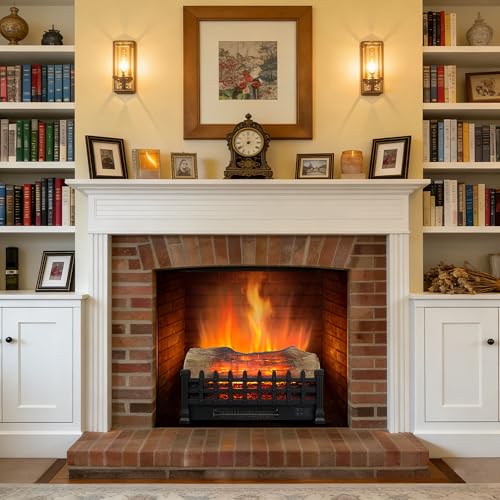
The EROMMY 24-Inch Ventless Fireplace Log Set is designed for existing masonry or factory-built fireboxes that already have access to a plumbed natural gas supply. It suits homeowners who want the warmth and visual ambiance of a log fire without the labor, ash cleanup, or chimney maintenance of burning real wood. Because this system is engineered strictly for natural gas, it cannot be adapted or converted for use with propane, making fuel verification a critical first step.
Heating performance relies on a 32,000 BTU vent-free gas burner that the manufacturer rates at 99.9 percent efficiency. Since the set does not vent through an open chimney flue, most generated warmth remains inside the living area, with coverage listed for areas up to 1,100 square feet. Operation is managed through an electronic pulse ignition system and a multifunctional wireless remote. The remote features both manual and thermostat modes, customizable temperature targets, Fahrenheit or Celsius displays, a child lock, and a failsafe timer that shuts down the burner after two hours if signal transmission ceases for fifteen minutes.
Visually, the arrangement includes six hand-painted ceramic logs styled after South American silk floss wood. These logs are engineered to withstand high firebox temperatures without breaking down or burning away. The package also includes a bag of decorative lava rock to dress the burner base and conceal the underlying pan, along with the wireless remote transmitter and receiver box.
Fit and installation require careful planning before purchase. The manufacturer specifies minimum firebox dimensions of 14 inches deep, 32 inches wide at the front opening, 22 inches wide across the rear wall, and 24 inches high. Measuring your firebox taper and clearance is essential to ensure the assembly fits properly and allows adequate combustion air circulation. Additionally, manufacturer safety guidelines state that any glass doors on the fireplace must remain wide open during operation to prevent severe heat buildup within the enclosure.
Prospective buyers should check local municipal codes and homeowner association rules before investing in any vent-free gas appliance, as some jurisdictions restrict or prohibit unvented indoor burners. For homes that meet code requirements and have the necessary natural gas line and firebox dimensions, this EROMMY set provides a capable, supplemental zone-heating option backed by essential automated safety shutoffs.
This 24-inch log set requires a minimum firebox footprint of 32 inches across the front opening, tapering to at least 22 inches at the rear wall.
A minimum interior depth of 14 inches and an interior height of at least 24 inches are mandatory to maintain proper combustion airflow and clearance around the burner assembly.
Always verify your existing firebox measurements, damper condition, and nearby wall clearances against the manufacturer installation manual before purchasing.
An integrated oxygen depletion sensor (ODS) serves as a core safety mechanism, cutting off gas delivery immediately if room oxygen levels decrease below safe thresholds.
The unit features a pulse ignition system and an automatic failsafe that shuts the gas valve off if remote signal communication drops for 15 minutes.
Glass doors on the fireplace must remain completely open during use to maintain required ventilation and prevent thermal damage to the surrounding enclosure.

Pros
- Comprehensive kit contains the burner, grate, media, damper clamp, and connection hardware
- Durable ceramic logs are internally reinforced with steel rods to resist thermal degradation
- Match-light setup eliminates reliance on household electricity, remotes, or complex wiring
- High-definition bark detailing offers the visual appearance of seasoned Live Oak firewood
Cons
- Requires a fully operational chimney with an open flue damper during all burning periods
- Designed exclusively for natural gas and cannot be used with liquid propane without approved conversion equipment
- Match-light operation lacks push-button ignition, thermostatic controls, or handheld remote functionality
The RealFyre 18-Inch Live Oak Vented Gas Log Kit is built for homeowners seeking to convert an existing wood-burning fireplace into a cleaner, low-maintenance gas hearth. Operating strictly on natural gas, this kit supplies the burner, log media, and essential installation accessories to establish an authentic flame display inside a masonry or factory-built vented firebox. It appeals to existing fireplace owners who want to eliminate wood hauling, soot accumulation, and ash disposal while retaining the visual aesthetic of real burning logs.
Operation relies on a manual match-light ignition system. Because this configuration does not incorporate an automatic safety pilot, electronic sparker, or wall switch, lighting the burner requires opening the manual gas valve and applying an external flame source such as a long fireplace match or butane lighter. The absence of electrical components simplifies ongoing operation, as there are no batteries to replace or circuit boards to service. While the manufacturer does not specify numerical BTU heat output ratings for this listing, the refractory ceramic logs are engineered to absorb heat from the burner flames and project supplemental radiant warmth into the living space even after the flame is extinguished.
Build quality centers on high-definition refractory ceramic construction. Each Live Oak log is individually hand-painted to emulate the texture and coloration of seasoned oak timber. Internal steel reinforcement rods run through the core of the logs to safeguard structural integrity under continuous firebox temperatures. The package includes the matched burner pan, a robust log grate, silica sand to diffuse the gas flow, glowing ember material to simulate a burning coal bed, and a flue damper clamp designed to keep the chimney flue permanently cracked open for safety.
Proper fit and installation require careful planning before purchase. The kit carries dimensions of 13 by 18 by 15 inches and a combined weight of 49 pounds. Prospective buyers must measure the front width, rear width, depth, and height of their existing firebox to ensure adequate clearance around the burner pan and grate assembly. Because this is a vented appliance, combustion gases must exit freely up a functioning chimney. The included damper clamp must be installed to prevent the chimney damper from closing completely, adhering to local building codes. Natural gas line connections must be checked for leaks, and homeowners uncertain of fuel line sizing or municipal plumbing requirements should consult a qualified gas technician.
While the complete nature of this kit simplifies sourcing parts, buyers should recognize its operational boundaries. This unit does not feature flame height adjustment via remote control, nor does it include a standing pilot with an automatic shutoff valve. It is not suitable for vent-free fireboxes or homes lacking a dedicated natural gas line. For homeowners with an active chimney and existing gas infrastructure who prioritize reliable manual controls, robust materials, and an attractive fire presentation over digital automation, the RealFyre Live Oak set serves as a durable, well-appointed hearth upgrade.
This complete vented fireplace logs kit provides all core hardware needed for a standard natural gas installation. Inside the 49-pound package, buyers receive the 18-inch natural gas burner assembly along with a matching heavy-gauge fireplace grate engineered to cradle the ceramic logs securely.
Decorative media includes a complete set of hand-painted refractory ceramic Live Oak logs, a bag of silica sand designed to disperse the gas evenly across the burner bed, and rock wool glowing embers that create a bright coal bed appearance during operation. A flue damper clamp is provided to maintain the required chimney opening, alongside the essential gas connection hardware needed to link the burner inlet to an existing residential gas supply pipe.
The RealFyre Live Oak set is categorized strictly as a vented gas appliance. It must be installed only in a functional, certified wood-burning firebox equipped with an operational chimney or flue system that vents directly to the outdoors. Operating this log set with a closed damper or inside an unvented enclosure can cause hazardous combustion byproducts, including carbon monoxide, to accumulate inside the home.
To help prevent accidental flue closure, the set includes a mandatory damper clamp that mechanically locks the fireplace damper in an open position. Homeowners must verify that the chimney flue has been inspected and cleaned of creosote or debris prior to burner installation, and all gas hookups should be tested for tight seals in accordance with local municipal codes and the manufacturer installation guide.

Pros
- Massive 30,000 BTU output provides rapid and consistent supplemental warmth for expansive rooms
- Dual fuel capability allows straightforward hookup to either natural gas lines or liquid propane tanks
- Dual burner system creates realistic, full-bodied flame aesthetics inside the firebox
- Durable cold-rolled steel construction provides a sturdy, traditional cast-iron aesthetic
- Continues to provide emergency heat during winter electrical power outages
Cons
- Circulation blower fan is sold separately and does not come standard in the box
- At 78 pounds, the unit requires two people for safe unboxing and placement
- Vent-free appliances require adequate room ventilation and may not be approved in all local building jurisdictions
The Pleasant Hearth VFS2-PH30DT is a freestanding, vent-free gas stove engineered to deliver robust supplemental heat without the need for an external chimney or venting system. Finished in a classic black finish with a cold-rolled steel body, this 32-inch unit fits naturally into spacious living rooms, finished basements, and open-concept family spaces. Homeowners seeking reliable warmth during cold snaps or looking to offset central heating bills will appreciate its timeless woodstove silhouette combined with clean gas efficiency.
With a maximum heat capacity of 30,000 BTU per hour, this intermediate stove is rated to warm areas up to 1,000 square feet. Based on product specifications, the stove incorporates a dual burner configuration that creates two distinct rows of lively flames. This setup produces strong radiant heat while delivering the visual ambiance of a traditional hearth fire. The integrated thermostat monitors ambient temperatures and cycles fuel delivery accordingly, helping prevent rooms from overheating while conserving fuel over long winter evenings.
Flexibility is a strong selling point for this model thanks to its dual fuel engineering. Homeowners can configure the unit to run on either liquid propane or natural gas, depending on existing home hookups. Because the stove operates primarily via natural air convection, it runs silently without distracting mechanical hums. Those who prefer pushed air circulation can purchase an optional add-on blower, but the standard convection draft does a commendable job circulating rising heat across large rooms.
Safety and clearance planning are essential with any vent-free indoor heating system. The stove includes an overheat sensor to help monitor safe operational temperatures. Owners should plan their floor space carefully, observing manufacturer guidelines that require at least 5 inches of rear wall clearance and 36 inches of clearance above the unit. Because the stove produces combustion warmth directly into the living space, ensuring baseline fresh air turnover is recommended for indoor comfort.
Setting up the Pleasant Hearth stove requires connecting it to a regulated gas source, meaning professional installation is strongly advised to verify gas pressure and seal connections safely. Once properly connected, the stove requires minimal upkeep beyond occasional dusting and burner checks. For homeowners needing dependable warmth that functions even during winter power failures, this freestanding stove represents a functional and visually comforting heating investment.
Generating up to 30,000 BTU per hour, this freestanding gas stove provides serious thermal output capable of heating expansive open living areas up to 1,000 square feet. The dual burner setup establishes two staggered rows of flames, yielding intense radiant warmth and an attractive visual depth inside the firebox.
Because the unit uses a vent-free design, thermal efficiency is exceptionally high since no warmth escapes upward through a chimney pipe. The onboard thermostat modulates flame output to maintain steady indoor temperatures, allowing you to use zone heating strategies to reduce reliance on primary furnace systems.
Proper placement requires observing minimum clearance distances of 5 inches from back walls and 36 inches from any overhead structures or mantels. Weighing approximately 78 pounds, the unit is solid and stable, making a two-person team helpful during transit and positioning.
Thanks to dual fuel capability, the stove accommodates liquid propane or natural gas connections. Given the precision required for gas line hookups and pressure regulation, hiring a licensed gas professional for final connection ensures code compliance and long-term peace of mind.

Pros
- Dual-fuel flexibility allows switching between natural gas and propane based on fuel availability.
- Ventless design avoids the expense and structural modifications of chimney installation.
- Zero-clearance firebox allows straightforward integration into custom mantels or recessed wall cavities.
- Comes complete with ceramic log set, iron grate, mesh screen doors, and remote receiver.
Cons
- Ventless gas appliances are subject to regional building code restrictions and may be prohibited in specific jurisdictions or bedrooms.
- Flame height modulation must be adjusted manually on the firebox valve rather than through the remote control.
The Duluth Forge FDF400RT-ZC is a dual-fuel ventless gas fireplace insert engineered to serve as a supplemental heat source or visual centerpiece in residential living areas. Designed for homeowners seeking the ambiance and heat of a traditional hearth without venting through an exterior chimney or flue, this insert fits well into custom recessed wall framing, prefabricated cabinetry, or existing masonry openings with access to a gas supply line. Because vent-free appliances release combustion byproducts into the living area, buyers must always verify local municipal codes and room-size guidelines before selecting a ventless model.
At the core of the insert is a burner rated by the manufacturer at 32,000 BTU, with a listed heating capability of up to 1,500 square feet. The unit features patented dual-fuel technology, allowing it to burn either natural gas or liquid propane depending on household utility connections. Starting the appliance relies on a push-button piezo ignition that lights a standing pilot. From there, users can turn the main flame on or off using the included handheld remote control with an LCD display, while flame height adjustments are handled manually at the control valve.
Visually, the insert replicates the look of an established hearth through six hand-painted ceramic fiber logs arranged over an iron grate, complemented by an interior sprayed brick liner. The black exterior measures approximately 29.1 inches wide, 29.5 inches deep, and 15.6 inches high, weighing roughly 70 pounds. Protective mesh double doors enclose the firebox face, creating a classic screened finish while maintaining an unobstructed view of the fire. The package also includes the remote receiver and a AAA battery to get the remote operational right away.
The zero-clearance construction permits the firebox to sit directly against framing studs or non-combustible materials when installed according to the manual. However, specific spatial clearances must be maintained, including a minimum of 42 inches between the top of the fireplace and the ceiling. Because proper gas line hookups, pressure regulation, and leak checks are vital for safe gas operation, hiring a qualified, licensed gas technician is strongly advised. Routine maintenance involves dusting the ceramic logs, clearing the burner ports of debris, and replacing remote batteries as needed.
Overall, the Duluth Forge FDF400RT-ZC presents an adaptable option for property owners wanting powerful supplemental heat and fuel flexibility in an all-in-one package. Its lack of required chimney venting can significantly streamline renovation budgets compared to vented alternatives. Prospective buyers should confirm their local building codes regarding ventless combustion appliances, ensure their room volume matches manufacturer minimums, and review gas line access before finalizing their purchase.
The zero-clearance firebox design allows this insert to be recessed into standard framing or built directly into a wall cavity, provided a qualified gas supply is available. The manufacturer specifies a mandatory clearance of at least 42 inches from the top of the appliance to the ceiling to ensure adequate thermal dispersion and prevent heat damage to surrounding finishes.
Because ventless appliances operate without an exhaust duct or chimney, they utilize room air for combustion. Prospective installers should verify that the room provides adequate cubic volume and ventilation as dictated by manufacturer instructions and local regulations. Gas line connections, fuel type configuration, and initial pressure testing should always be performed by a licensed professional.
Featuring dual-fuel capability, this insert can be connected to either an existing natural gas supply or a dedicated liquid propane tank line. The internal system operates at up to 32,000 BTU, providing high-efficiency zone heating directly into the living space without the draft losses associated with open chimneys.
Ignition is initiated via a push-button piezo system that activates a standing pilot. Once the pilot is established, the included remote control can cycle the main burner on and off. Users can fine-tune flame intensity and heat output using the manual control knob located behind the unit access panel.
The Duluth Forge FDF400RT-ZC arrives with the zero-clearance black firebox, integrated burner assembly, and an internal sprayed brick liner. Decorative components include six hand-painted ceramic fiber faux logs, an iron grate, and protective mesh double doors.
For operational control, the package contains a handheld remote control with an LCD screen, a corresponding remote receiver, and a single AAA battery to power the handheld transmitter.

Pros
- Durable heat-resistant ceramic construction holds its shape under high flame temperatures
- Ten separate pieces permit customized stacking across a variety of firebox or fire pit layouts
- Approved for use in both vented indoor fireplaces and outdoor gas fire pits
- Detailed bark texture provides an attractive traditional wood aesthetic without ash or wood cleanup
Cons
- Individual log dimensions and lengths are not specified in the manufacturer documentation
- Burner pan, fireplace grate, and gas connection components are not included and must be sourced separately
- Intended only for vented gas systems and outdoor pits, making it incompatible with unvented or vent-free indoor fireboxes
The Barton 10-Piece Ceramic Gas Fireplace Log Set is a decorative accessory designed to enhance the visual appeal of compatible vented indoor gas fireplaces, fireplace inserts, and outdoor gas fire pits. This set appeals to homeowners looking to upgrade worn decorative media or replace an aging log display without altering their existing gas infrastructure. Because it is purely decorative media, it serves fire features that already have an operable burner system, grate, and venting setup in place.
This decorative log set does not generate heat independently, nor does it include a burner or control valve. Instead, it is engineered to rest over or around an existing gas burner assembly where gas flames can flow between the ceramic pieces. The manufacturer specifies compatibility with vented gas fireplaces, fireplace inserts, and outdoor gas fire features. It is not designated for vent-free indoor setups, where precise factory-engineered log placement and specific emissions ratings are strictly regulated by appliance certifications.
Each set includes ten individual ceramic logs finished in a realistic wood style with molded bark textures and organic branch shapes. Made from heat-resistant ceramic material, the pieces are built to withstand direct exposure to gas flames while retaining their physical structure over time. Weighing approximately 7.4 pounds altogether, the collection provides enough pieces to build a layered, three-dimensional stack on a standard fireplace grate or fire pit burner pan.
Because the logs are separate, users can customize their arrangement by layering larger pieces at the base and stacking smaller branches across the top. When positioning the logs, it is necessary to follow the burner manufacturer instructions regarding flame impingement, burner port clearance, and pilot assembly access to prevent improper combustion or excessive soot accumulation. Handling ceramic logs requires care to avoid chipping or surface breakage, and routine maintenance generally involves gently brushing away loose carbon or dust while the system is cool and completely shut off.
A key consideration before purchasing is that specific dimensions for each of the ten logs are not provided, meaning buyers must estimate how the 7.4-pound collection will fill their specific firebox or fire pit opening. Additionally, buyers must supply their own burner pan, grate, and gas plumbing, as this product consists solely of decorative media. For homeowners and patio owners with an existing vented gas burner seeking an attractive, reconfigurable wood-style arrangement, this Barton set provides a straightforward aesthetic upgrade.
The Barton 10-piece log set is designed specifically for vented indoor gas fireplaces, fireplace inserts, and outdoor gas fire pits. It is intended to function as decorative media placed atop existing burner pans or grates.
Because indoor vent-free fireplaces require certified, manufacturer-specific log positioning to ensure proper combustion and prevent carbon monoxide accumulation, these loose ceramic logs should not be used in unvented appliances unless explicitly permitted by the appliance manufacturer. Always verify that log placement does not obstruct burner ports, pilot assemblies, or safety sensors.
Routine care for ceramic gas fireplace logs helps maintain their appearance and clean operation. Before handling the logs, ensure that the gas supply is turned off and the entire fire feature has cooled completely.
Ceramic logs can be cleaned by gently brushing away surface dust and carbon deposits using a soft-bristle brush. Avoid using harsh chemical cleaners, abrasive scrubbers, or soaking the logs in water, which can damage the ceramic material or affect its heat resistance during subsequent burns.
Pros
- Flexible dual-fuel capability allows operation with either natural gas or liquid propane lines.
- Thermostatic cycling helps regulate room comfort automatically without continuous manual adjustments.
- Zero-clearance design provides flexible installation options for recessed framing or custom mantel cabinets.
- Ventless configuration eliminates the need for an external chimney, flue, or venting ductwork.
Cons
- Ventless gas appliances are subject to regional and local code restrictions that must be verified prior to installation.
- Requires a minimum 42-inch clearance from the top of the unit to the ceiling, which may restrict placement in rooms with low ceiling heights.
The Duluth Forge FDF400T-ZC is a zero-clearance, ventless gas fireplace insert engineered for homeowners seeking powerful supplemental heat without the structural demands of an exterior chimney or flue. Designed for indoor installation in rooms with accessible gas piping, this unit functions effectively as a replacement insert inside a suitable fireplace opening or as the core component of a custom-built mantel enclosure. Its dual-fuel configuration makes it an adaptable option for property owners utilizing either utility natural gas or bottled liquid propane.
At the center of its operation is a dual-fuel burner capable of producing up to 32,000 BTUs, operating with a manufacturer-stated 99.9% vent-free efficiency rating. Duluth Forge rates this heat output for living spaces up to 1,500 square feet under typical residential conditions. The built-in thermostat control continuously monitors ambient room temperature, cycling the gas burner on and off to maintain a consistent comfort level rather than requiring ongoing manual flame adjustments. Ignition is managed by a battery-operated push-button piezo system that uses a single included AAA battery, allowing reliable startup without requiring an electrical outlet or household wiring.
Visually, the insert features a traditional fireplace appearance centered on six hand-painted ceramic fiber faux logs positioned on a heavy iron grate. The interior of the firebox features a sprayed brick liner for added depth, while the exterior presents a clean black finish accented by operable mesh double doors. Listed dimensions measure 29.1 inches wide, 29.5 inches deep, and 15.6 inches high, with a total weight of approximately 70 pounds, providing a solid footprint intended to fill standard hearth openings or custom framing cavities.
Installation requires careful review of framing clearances, gas supply requirements, and local code restrictions. Because this is a zero-clearance firebox, it is designed for recessed installation against standard wall framing or into an enclosure accessible to a gas supply. However, the manufacturer dictates that clearance between the top of the firebox and the ceiling must not be less than 42 inches. Because vent-free gas appliances release combustion byproducts directly into the room, prospective buyers should always confirm that local building codes and municipal regulations permit unvented gas appliances in their specific area prior to purchase.
The Duluth Forge FDF400T-ZC serves as an efficient heating solution for homeowners looking for substantial zone heat and versatile fuel compatibility. The absence of exterior venting simplifies placement in homes lacking an existing flue, provided that room dimensions and required ceiling clearances are strictly respected. For households with accessible gas lines seeking a dependable, thermostatically controlled hearth appliance, this model combines practical heating performance with classic fireplace aesthetics.
The zero-clearance firebox design of the Duluth Forge FDF400T-ZC enables flexible installation, whether recessed into standard interior wall framing or housed inside a compatible fireplace mantel surround. Because it does not require an external chimney, chimney liner, or exterior ducting, installation focuses primarily on proper gas line connections and structural clearance compliance.
A critical manufacturer specification is the required clearance to combustible ceilings, which must be a minimum of 42 inches measured from the top of the fireplace insert. Adequate room volume is also necessary to support proper combustion for unvented appliances. Homeowners should consult the manufacturer manual and work with a licensed gas technician to ensure correct piping, pressure regulation, and adherence to municipal codes regarding vent-free indoor heating appliances.
Featuring patented dual-fuel technology, the FDF400T-ZC is engineered to operate on either natural gas or liquid propane without requiring separate conversion kits. This versatility allows homeowners to select the most economical or available fuel source for their household setup.
The burner produces up to 32,000 BTUs of supplemental heat with a 99.9% efficiency rating, as no thermal energy escapes through an exhaust vent. Duluth Forge rates this appliance to heat areas up to 1,500 square feet. An integrated thermostat automates the heating cycle to maintain target room temperatures, while the piezo ignition provides straightforward startup without relying on household electrical power.
Gas Fireplace Venting: Requirements and Safety
The primary difference between vented and ventless gas fireplaces lies in how they handle combustion gases. Vented systems, such as direct-vent or natural-draft units, must channel smoke, carbon dioxide, and water vapor outside the home. This is mandatory for most natural gas and liquid propane fireplaces that produce visible flames and heat through open combustion. Ventless units, on the other hand, are engineered to be 100% efficient by retaining all heat in the room, but they still require strict safety controls to prevent the accumulation of combustion byproducts indoors.
| Feature | Vented Gas Fireplace | Ventless Gas Fireplace |
|---|---|---|
| Exhaust Requirement | Chimney or direct vent pipe to outside | No external vent required |
| Air Source | Often sealed (direct vent) or uses room air (natural draft) | Uses room air for combustion |
| Efficiency | Typically 70-85% (direct vent) | Nearly 100% (heat retained in room) |
| Moisture Output | Minimal indoor moisture | Releases water vapor into the room |
| Code Restrictions | Fewer restrictions in most areas | Banned or restricted in some jurisdictions |
Before assuming you can skip venting, you must identify the type of fireplace you have. The manufacturer’s label or installation manual will explicitly state the venting requirements. Direct-vent fireplaces are sealed systems that draw outside air for combustion and exhaust gases outside, making them independent of the indoor air quality.
Natural-draft fireplaces rely on the natural rise of hot gases up a chimney, which can be affected by wind and indoor air pressure. Vent-free fireplaces are a distinct category that does not use a chimney but must be installed in accordance with specific clearance and ventilation rules.
Local building codes play a significant role in determining what is permissible. Some states and municipalities have banned the use of vent-free gas appliances due to concerns about carbon monoxide and nitrogen dioxide levels. Even in areas where they are allowed, they may only be permitted in rooms of a certain size with specific airflow rates. Always check with your local building department to confirm that your planned installation meets current regulations. Ignoring these codes can result in failed inspections, insurance issues, or health hazards.
Identifying Vented vs. Ventless Systems
Visual inspection is the first step in determining your fireplace’s venting needs. Look for a pipe or flue extending from the fireplace unit to the outside of the home. Direct-vent systems typically have a double-wall pipe that is visible through the wall or ceiling. If you see a traditional masonry chimney, the unit is likely vented, either natural draft or power-vented. If there is no visible exhaust pipe and the unit is labeled “vent-free” or “ventless,” it is designed to operate without an external vent.
Check the product label or nameplate for specific model details. The label will often include the fuel type (natural gas or propane) and the venting classification. For example, a model labeled “Direct Vent” must be connected to a venting system. A model labeled “Vent Free” will not have a vent connection point. If you are replacing logs or an insert, ensure the new component matches the venting type of the existing fireplace. Installing vent-free logs in a vented fireplace, or vice versa, can create dangerous conditions.
Safety Features and Oxygen Depletion Sensors
Ventless gas fireplaces rely on Oxygen Depletion Sensors (ODS) to ensure safety. These sensors monitor the oxygen levels in the room and shut off the gas supply if levels drop below a safe threshold. This is a critical feature that prevents the unit from operating in an environment with insufficient oxygen. Vented fireplaces also have safety features, such as thermocouples that ensure the pilot light is lit before the main burner ignites, but they do not require ODS because they are exhausting combustion products outside.
It is important to maintain these safety features. Do not block the air intake or exhaust ports, as this can interfere with the ODS or the draft. Regularly clean the glass doors and vents to ensure proper airflow. If you notice soot buildup, a yellow flame, or a strong gas smell, turn off the fireplace immediately and contact a qualified professional. These signs indicate a venting issue or a malfunction that could lead to carbon monoxide exposure.
Local Codes and Permit Requirements
Building codes vary by location, and what is allowed in one city may be prohibited in another. Some jurisdictions require permits for the installation of any gas appliance, including fireplaces. Others may have specific restrictions on vent-free units, such as limiting their use to rooms with a minimum square footage or requiring additional ventilation. Before purchasing or installing a gas fireplace, contact your local building authority to understand the specific requirements for your area.
Failure to comply with local codes can result in fines, the requirement to remove the unit, or issues with home insurance. It is also a safety risk, as non-compliant installations may not have the necessary safeguards to prevent carbon monoxide buildup or fire. Always hire a licensed contractor for gas fireplace installation, as they will be familiar with local codes and best practices. If you are unsure about your current installation, consider having it inspected by a professional to ensure it meets current standards.
Maintenance and Venting Inspection
Regular maintenance is essential for both vented and ventless gas fireplaces to ensure safety and proper function.
- Vented units require annual inspection of the chimney or vent pipe for creosote buildup, cracks, or blockages.
- A blocked vent can cause dangerous backdrafting, where combustion gases are pushed back into the home.
- Ventless units focus on cleaning the logs, burner, and ODS to ensure they function correctly.
- Dust and debris can interfere with the sensor and the flame, leading to unsafe operation.
Keep a record of your maintenance activities, including the date of inspections and any repairs. This documentation can be helpful when selling your home or dealing with insurance claims. If you notice any issues with your fireplace, such as smoke in the room, a strange odor, or difficulty lighting, do not use the unit until it has been inspected by a professional.
Ignoring these signs can lead to serious safety hazards and costly repairs. For more information on maintaining your fireplace, see our small space heater guide for tips on safe operation in compact areas.
Choosing the Right Venting for Your Home
When selecting a gas fireplace, consider the venting options that best suit your home and your needs. Direct-vent fireplaces are a popular choice for their safety and efficiency, as they are sealed systems that do not affect indoor air quality. They are ideal for homes with existing chimneys or for new installations where a direct vent can be easily routed. Natural-draft fireplaces are a good option for homes with a traditional masonry chimney, but they may be less efficient and more susceptible to draft issues.
Ventless fireplaces offer the highest efficiency and are easier to install, as they do not require a chimney or vent pipe. However, they are subject to more restrictions and may not be suitable for all homes or climates.
In humid climates, the moisture released by ventless units can contribute to indoor humidity levels, which may lead to condensation or mold growth. Consider your local climate and your home’s ventilation when making your decision. If you are unsure which type is best for you, consult with a fireplace professional who can assess your specific situation.
- Check the manufacturer label for venting classification.
- Verify local building codes for vent-free appliance restrictions.
- Inspect the chimney or vent pipe for blockages annually.
- Ensure Oxygen Depletion Sensors are clean and functional.
- Never install vent-free logs in a vented fireplace.
- Hire a licensed contractor for gas line connections.
Common Mistakes to Avoid
One of the most common mistakes is assuming that all gas fireplaces are the same. Vented and ventless units have different requirements, and mixing them up can be dangerous. Another mistake is ignoring local codes, which can lead to compliance issues and safety risks. Always research the specific rules in your area before purchasing or installing a gas fireplace.
Another error is neglecting maintenance. A dirty or blocked vent can cause serious problems, including carbon monoxide leaks and fire hazards. Regular cleaning and inspection are essential to keep your fireplace operating safely and efficiently. Do not attempt to modify the venting system or bypass safety features, as this can void your warranty and create dangerous conditions. Stick to the manufacturer’s instructions and local codes to ensure a safe and enjoyable fireplace experience.
Ultimately, the decision to vent a gas fireplace depends on the type of unit you have and the regulations in your area. Vented fireplaces require a chimney or direct vent pipe, while ventless units do not but must comply with strict safety standards. By understanding these differences and following local codes, you can ensure your gas fireplace is safe, efficient, and compliant. Always consult with a professional if you have any doubts about your installation or maintenance needs.


Write Your Review
No reviews yet. Be the first to share your experience!